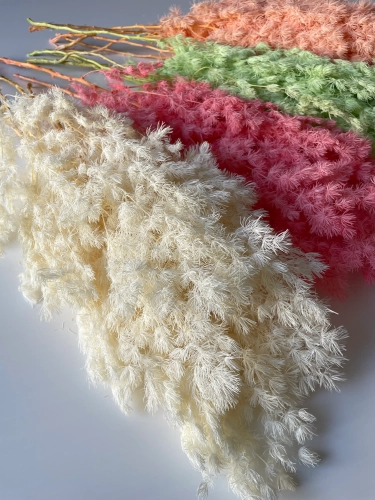
Asparagus
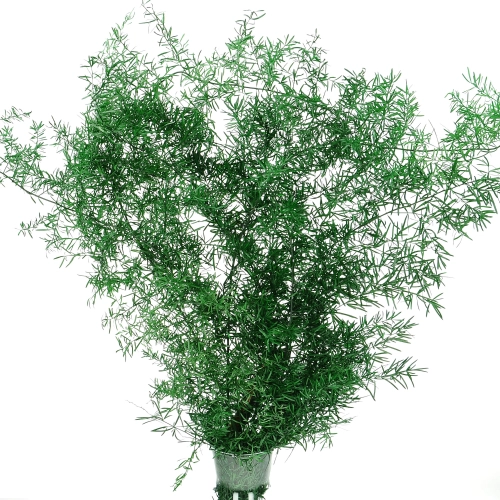
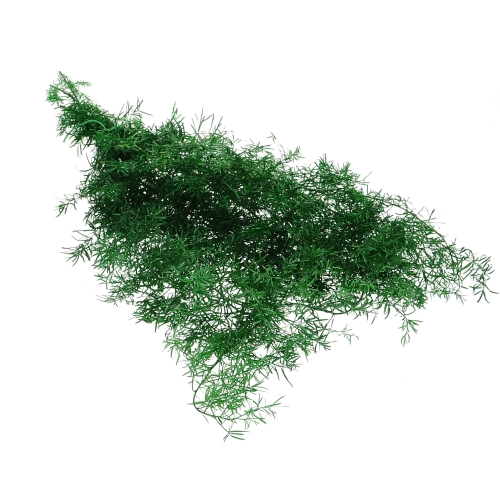
Asparagus is a perennial plant belonging to the asparagus family, which is found in Africa, Asia and Central Europe. Two varieties are best known: asparagus retrofractus (Ming fern) and asparagus Sprengeri. The former has leaves with a delicate and openwork habit, which is why it is often mistakenly called a fern. The latter develops long stems densely covered with fine leaves. Both plants are closely related to asparagus, which is a tasty and healthy vegetable that appears on plates in spring. Feather asparagus and Sprengeri’s asparagus are also prized species in floristics. Years ago, they were used as cut greens. Today, preserved asparagus, which retains all its aesthetic qualities and is more durable, is much more popular.
What does asparagus look like?
Asparagus is classed as a semi-shrub, meaning that it has a woody stem base. It develops fairly long, slightly curved stems that branch out quickly. As a result, the plant forms a lush clump, which makes it look very decorative. Interestingly, this species develops two types of leaves. The first are the proper leaves, which grow in the lateral branches of the shoots and take on a small, scaly form. The second are the so-called branchlets, which are transformed shoots that take the form of needles growing several at a time from a single node. Asparagus has small, dense white or cream-coloured flowers clustered in clusters. After flowering, they transform into red berries.
Asparagus under natural conditions and in cultivation
Asparagus is native to southern Africa. Under natural conditions, it grows in forests. It can also be found in coastal dunes and rocky areas. The plant is very popular in Asia. Until recently, it was popularly cultivated in China as an ornamental species in gardens and flowerbeds. However, asparagus has now been recognised as a highly invasive plant there, which also appears in a feral form in wastelands and meadows.
Some species of asparagus are also found in Europe. In Poland, due to its poor frost resistance, the plant is mainly grown as a pot species. Because it branches beautifully, it looks striking in tall flowerbeds and dressers. It is trouble-free to grow. Asparagus prefers semi-shaded positions or with diffused light. However, it does not tolerate direct sunlight. A humusy and well-drained soil is ideal for it. The plant should be watered regularly, but care should be taken to allow the substrate to dry out slightly from time to time. This species develops root tubers in which it stores water. In the wild, it experiences periodic drought, so it is not advisable to overwater the substrate. In summer, the plant can be put out in the garden, on a balcony or terrace, taking care, however, that the place is not too sunny. Interestingly, asparagus does not tolerate tobacco smoke or fumes, including those rising from a gas cooker.
Use of asparagus
Until recently, asparagus was a common pot plant. It also found use as cut greenery. It was perfect as a filler for bouquets and other living plant compositions. Over the years, however, its popularity has strongly declined. Today, asparagus is making a big comeback in a stabilised form, allowing it to retain its beautiful appearance and ensuring its durability.
Stabilised asparagus in floristry
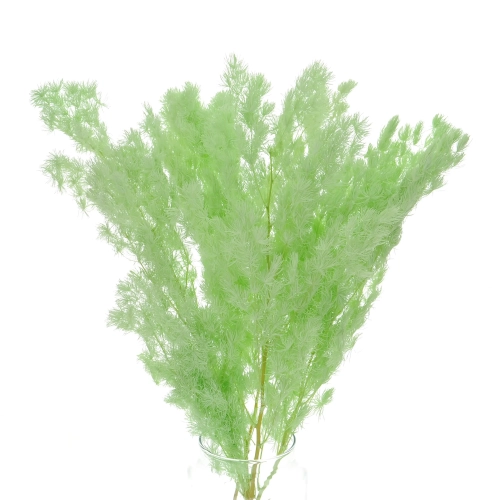
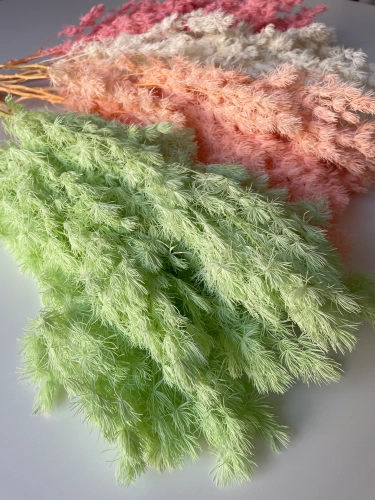
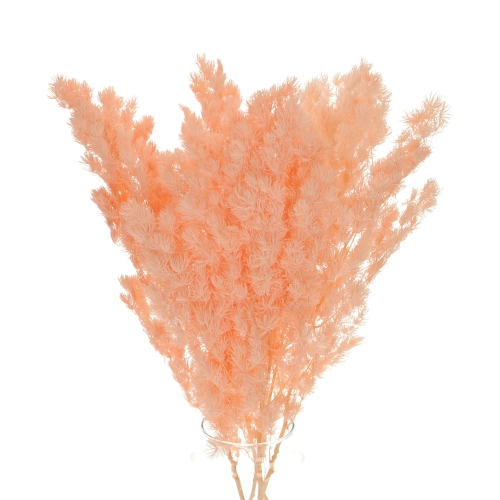
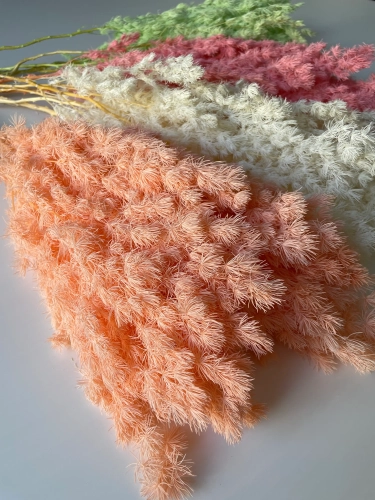
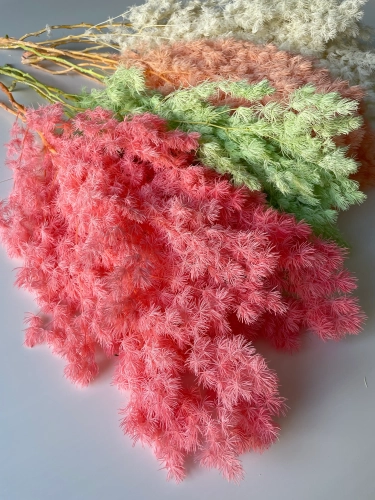
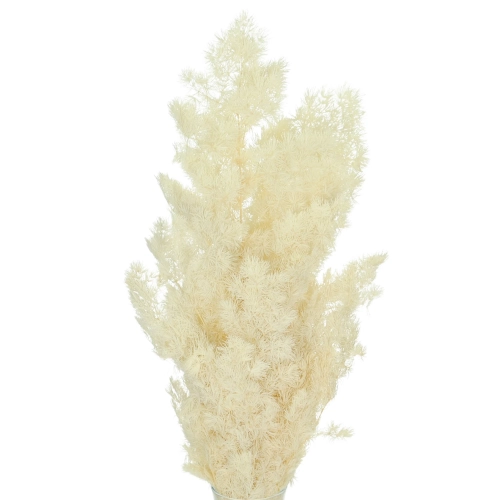
Preserved asparagus is a veritable mine of floral inspiration. It works well in both cut flower bouquets and dried flower compositions. It is available in coloured variants, so you can easily match it with the colours of other plants. It can be combined with exotic species such as banksia or protea. It will also look great with thistles or echinops. It should be noted that stabilised asparagus is not only suitable as a complement to a bouquet. It is an ideal choice for cloud-type installations suspended from the ceiling and decorating wedding and banquet halls or restaurants. It looks great as a photo wall decoration. It can be embedded in resin or displayed under a lampshade. Stabilised asparagus also looks great solo. Placed in a simple glass vase, it will become a perfect decoration for a modern interior.
Stabilised asparagus at Blosmi
At Blosmi you will find stabilised asparagus in several colour variants. In one bundle you will find sprigs with a weight varying between 80 and 100 g. The shoots can vary in height and in spread. All plants are carefully packed and protected for transport.