Lunaria
Lunaria (Lunaria annua), known as annual honesty, is an annual or biennial plant belonging to the Brassicaceae family. Its natural habitat is Central and Eastern Europe, especially the Balkans. However, this species has spread throughout the Old Continent as an ephemerophyte, i.e. a plant that has been introduced to a given area and has been present there permanently or temporarily ever since. Lunaria also grows wild in Poland. It is also an excellent garden plant. After flowering, it develops beautiful, translucent seed pods, making it an ideal species for drying.
What does lunaria look like?
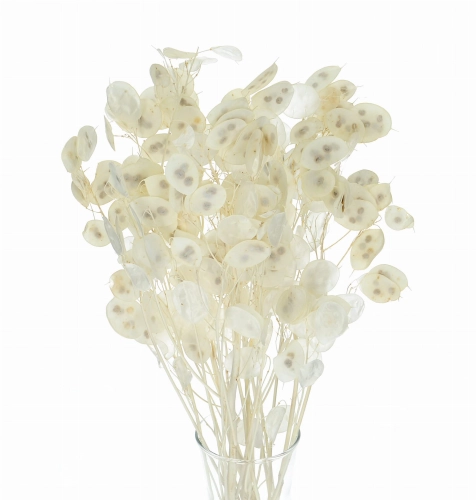
The annual honesty plant can reach a height of 30 to 100 cm. It has stiff stems that branch out at the top, bearing clusters of pink or white flowers. An interesting fact is that lunaria is pollinated by moths. The species blooms from June to the end of July. The leaves of the plant are heart-shaped with serrated edges. At the bottom, they have a stalk, and at the top, they are sessile. Both the stem and leaves of the monthly are covered with soft, short hairs. However, the greatest asset of lunaria is its fruit. The oval, and sometimes even round, capsules have two translucent covers and a silvery partition to which the fruits are attached. Their appearance resembles coins, which is why lunaria is commonly called Judas silver. For drying, the shoots should be cut when the capsules are not yet completely dry and have a slightly greenish colour. Lunaria is best dried using the herbal method.
Lunaria in its natural habitat and in the garden
In its natural environment, annual mercury is most commonly found in shaded forests, ravines and riverbanks. It grows best in semi-permeable and slightly moist locations. It grows wild on forest edges, wasteland and sometimes ruderal areas. However, it is most commonly found as a garden plant. It goes well with other species grown for drying, including helichrysum, nigella, physalis and ammobium. It can be planted with perennials such as hollyhocks, dahlias and foxgloves, or near shrubs. Lunaria is an excellent choice for both country-style and modern gardens.
Lunaria does not require special growing conditions. It grows well in both shady and sunny areas of the garden. It is only necessary to ensure that the plant has well-drained soil, preferably with a neutral or slightly alkaline pH. Lunaria should have constantly moist soil. It is best to grow it as a biennial plant. To do this, sow the seeds in seedbeds in June and then plant the plant in the right place in the garden in autumn. However, it is worth remembering that the plant develops large, tuberous roots, which makes it very difficult to transplant. Lunaria is resistant to pests.
The use of lunaria
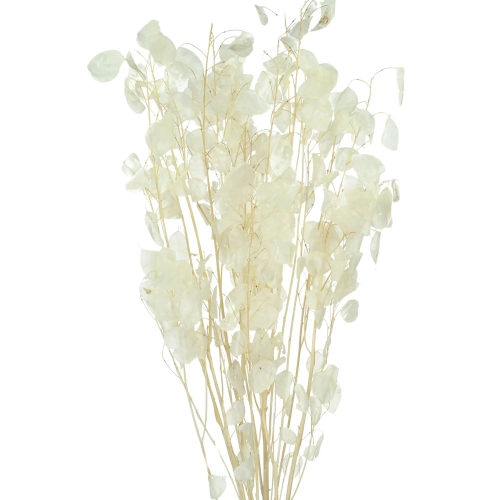
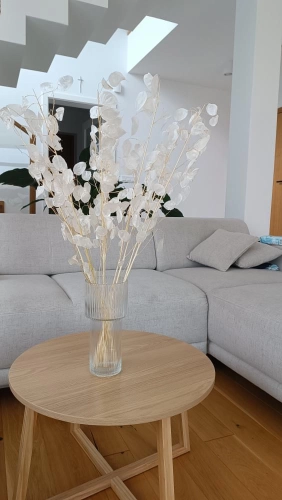
Lunaria is mainly cultivated for dry bouquets that can be used to decorate homes or venues for special events. Dried honesty looks great both in its natural form and bleached. It is a perfect complement to other dried flowers. In this form, it can be used to create wonderful bouquets that decorate rustic and traditional interiors. It looks impressive when hung from the ceiling, especially in buildings with exposed roof trusses. In a modern setting, dried lunaria can be combined with linum, gypsophila, bleached fennel and even eryngium, creating original compositions that fit in with the minimalism of modern spaces. It is worth remembering that dried lunaria looks great on its own – placed in slender glass vases.
Dried lunaria at Blosmi
Blosmi offers dried lunaria in its natural, silvery or bleached colour. The tallest branches in a bunch reach a height of about 70 cm. For smaller compositions, lunaria grown in Poland is ideal. All plants are carefully packaged before shipping to ensure they arrive safely at their destination.
|